


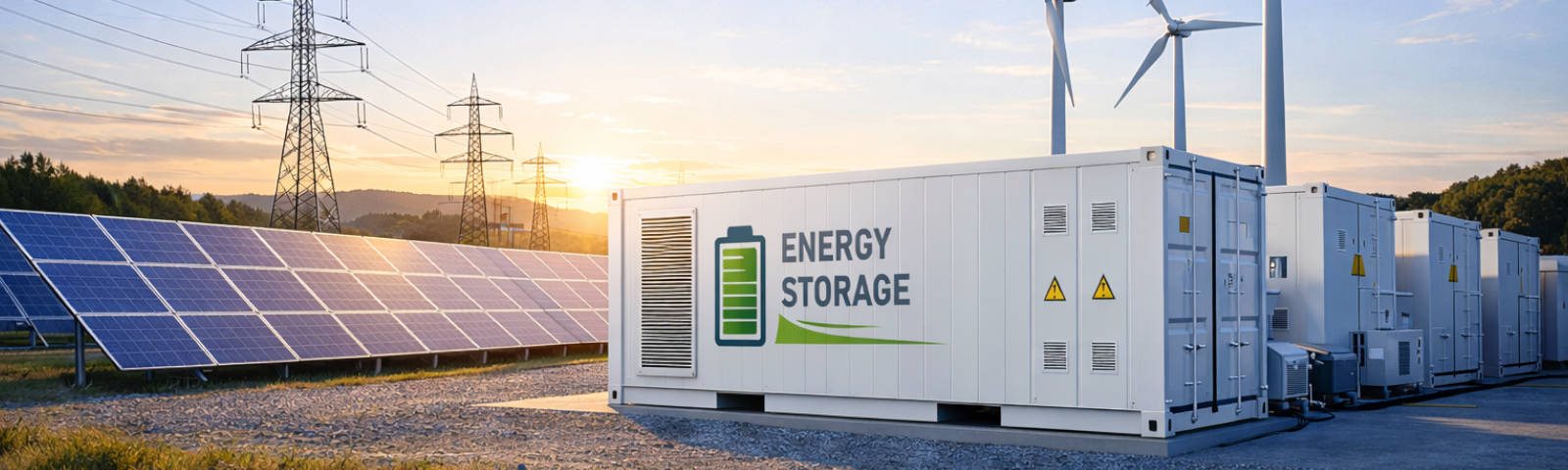
Energy storage for home and business
An energy storage system can be compared to a reservoir that stores electricity when it is available or cheap, and releases it when it is needed or more expensive. In practice, this means greater independence from the grid, better use of your own photovoltaic energy, and the possibility of backup power. At the same time, it’s worth noting that this is not a one-size-fits-all solution and does not always deliver the same results. The key is to match the storage system to your energy consumption profile and the goal you want to achieve.
How does an energy storage system work in practice?
In a typical residential installation, an energy storage system (see ready-made home energy storage systems) works with a hybrid inverter (or an inverter with an additional control system), which decides where the energy should come from at any given moment: from photovoltaic panels, from the battery, or from the grid. During the day, when PV production exceeds current consumption, the surplus can be used to charge the battery. In the evening and at night—when PV production is minimal—the home uses the energy stored in the battery. If the stored energy runs out, the system seamlessly switches back to the grid.
In businesses, the principle is similar, although the scale is larger and control is more advanced. The storage system (check industrial energy storage solutions) can stabilise power demand, reduce peak loads, support PV operation, or follow energy pricing schedules. Increasingly, a key role is played by an energy management system (EMS), which “organises” storage operation over time, taking into account consumption profiles, production forecasts, and energy prices.
Why do people and businesses choose energy storage?
The most common reason is simple: better use of your own photovoltaic system. In many homes, energy consumption peaks in the afternoon and evening—cooking, lighting, household appliances, charging electronics, or heating. Meanwhile, PV systems produce the most energy during midday, when consumption is often lower. Energy storage “shifts” part of this daytime production to evening hours, increasing self-consumption—meaning the actual use of your own electricity on-site.
Another reason is energy costs and the growing importance of time-based tariffs. If electricity prices vary significantly throughout the day, the storage system can charge during cheaper periods (from PV or the grid) and discharge when prices are higher. This scenario is especially attractive where consumption is predictable or can be partially controlled.
A third reason is energy security. A well-designed system can maintain power to selected circuits in a home or business when the grid goes down: lighting, routers, monitoring systems, pumps, gate automation, selected sockets, and sometimes even larger loads—depending on the storage system’s capacity and configuration. This is particularly important in areas where power outages occur regularly or where even a short interruption can cause problems.
Benefits of energy storage – what do you actually gain?
In residential applications, the most noticeable benefit is greater comfort and predictability. When the system is properly sized, a large portion of evening consumption can be covered by energy generated during the day. For many users, there is also a psychological benefit: the awareness that you are using your own energy instead of purchasing it at higher rates.
Another key advantage is backup operation. While an energy storage system does not always replace a traditional UPS in applications requiring instantaneous switching, it can ensure continuity of critical circuits and help you get through outages without disruption. For businesses, this is not just about convenience but also about avoiding real losses—such as interrupted cooling, halted processes, or failures in IT and monitoring systems.
In business applications, energy storage can also deliver a tangible benefit: peak shaving. If a company experiences short but high spikes in power demand, the storage system can “smooth” these peaks, helping to keep consumption within defined limits. Depending on contracts and billing structures, this can lead to measurable savings or make it easier to operate within grid constraints.
Drawbacks and pitfalls – when does storage disappoint?
The most common source of disappointment is choosing the wrong objective. An energy storage system is not a magical device that always reduces electricity bills. Its effectiveness depends on the consumption profile. If most energy is used during the day—exactly when PV is producing—and evening consumption is low, there may be little energy to “shift.” Similarly, if the PV system is small and consumption is high and constant, the battery may discharge quickly, limiting the benefits.
Another common issue is confusing capacity with power. Capacity (kWh) indicates how much energy the system can store, while power (kW) determines how quickly it can deliver that energy. You may have a large-capacity battery, but if its output power is too low, it may not support key loads simultaneously or handle startup currents of devices such as pumps, compressors, or HVAC systems.
A third consideration is backup functionality. Not every storage system provides backup power “as advertised.” In practice, system architecture, installation design, and switching parameters matter. Sometimes backup works only for selected circuits, only on a single phase, or requires a dedicated distribution board for critical loads. If full-home or full-business backup is the goal, the system must be carefully designed with costs and limitations in mind.
Efficiency is also important. Charging and discharging a battery involves losses, as energy passes through power electronics. Therefore, storage delivers the best results when it replaces expensive grid consumption or increases self-consumption—not when it operates without a clear purpose.
Who is energy storage a good fit for?
Energy storage works best in homes with photovoltaic systems and significant energy use in the afternoon and evening. If a household uses appliances that operate heavily during these hours—such as kitchens, heating systems, air conditioning, electronics, or EV charging—the storage system can significantly improve PV utilisation. It is also a good choice where backup power is important, especially in areas with frequent outages.
In businesses, storage makes sense when there are peak demand charges or high costs during peak hours. It is also useful where grid infrastructure is limited and companies need to stay within connection limits, or where consumption is high in the evening and night while PV production occurs during the day.
On the other hand, storage may be less effective when overall consumption is very low, when most energy is used during PV production hours, or when the priority is rapid return on investment without additional features such as backup. This does not mean the system will not work—but the economic benefit may be lower, and the decision becomes more about comfort and strategy than cost savings.
What should you combine energy storage with for best results?
The most natural partner is, of course, a photovoltaic system. Storage allows you to collect surplus energy during the day and use it when PV is not producing. The next layer involves a hybrid inverter or, in larger installations, a dedicated PCS system. These components ensure safe, stable operation and convert stored energy into usable electricity for the installation.
Combining storage with an energy management system (EMS) is also highly beneficial, especially if you want to control operation beyond simple “charge when surplus exists” logic. EMS can incorporate tariffs, hourly pricing, weather forecasts, and backup priorities. This enables scenarios such as reserving part of the battery for backup while using the rest to optimise energy costs.
In homes, storage is often combined with heat pumps, air conditioning, or EV chargers—loads that can significantly benefit from optimisation. With proper control, part of their operation can be shifted to PV production hours. In businesses, storage is typically integrated with automation and monitoring systems to manage loads and control grid power consumption.
If backup is a priority, it is essential to separate critical circuits. This ensures that the system does not need to be oversized for the entire facility while still providing power to key loads during outages. A well-designed backup system is not just about the battery—it also involves proper configuration, protection, distribution systems, and prioritisation.
How should you approach choosing an energy storage system?
The best starting point is answering one question: “What do I need the storage system for?” If the goal is self-consumption, capacity should match evening and nighttime demand. If the goal is cost optimisation, tariffs and control strategies are key. If backup is the priority, output power, switching time, number of phases, and the list of supported loads become critical.
Only then should you select the appropriate capacity (kWh), power (kW), system architecture (hybrid or PCS), scalability, and compatibility with the inverter and metering system. In practice, many issues arise when systems are selected based only on capacity without considering whether they can realistically support loads in a given scenario.
Summary: energy storage is a tool, not a gadget
An energy storage system can be a highly effective and practical component of an installation—provided it is properly matched to consumption patterns and clearly defined goals. For some, it means maximising PV utilisation; for others, backup power; and for businesses, peak shaving or cost optimisation over time.
If you want to approach the topic wisely, start by answering three questions: how much energy you use in the evening and at night, how important backup power is to you, and whether your tariff structure allows you to benefit from time-based optimisation. Based on this, you can select a solution that genuinely improves costs, comfort, and energy security—rather than leading to disappointment.